[ad_1]
It was no straightforward process, contemplating nearly all of the fabric floor is a craggy, disordered mess. The researchers used ultrahigh precision measurement instruments developed within the lab of Jenny Hoffman, the Clowes Professor of Science and senior writer of the paper, to discover a appropriate, atomic-scale patch of samarium hexaboride.
Subsequent, the staff got down to decide if the fabric was topologically insulating by sending waves of electrons via the fabric and scattering them off of atomic defects — like dropping a pebble right into a pond. By observing the waves, the researchers may work out the momentum of the electrons in relation to their vitality.
“We discovered that the momentum of the electrons is straight proportional to their vitality, which is the smoking gun of a topological insulator,” mentioned Pirie. “It’s actually thrilling to be lastly transferring into this intersection of interacting physics and topological physics. We don’t know what we’ll discover right here.”
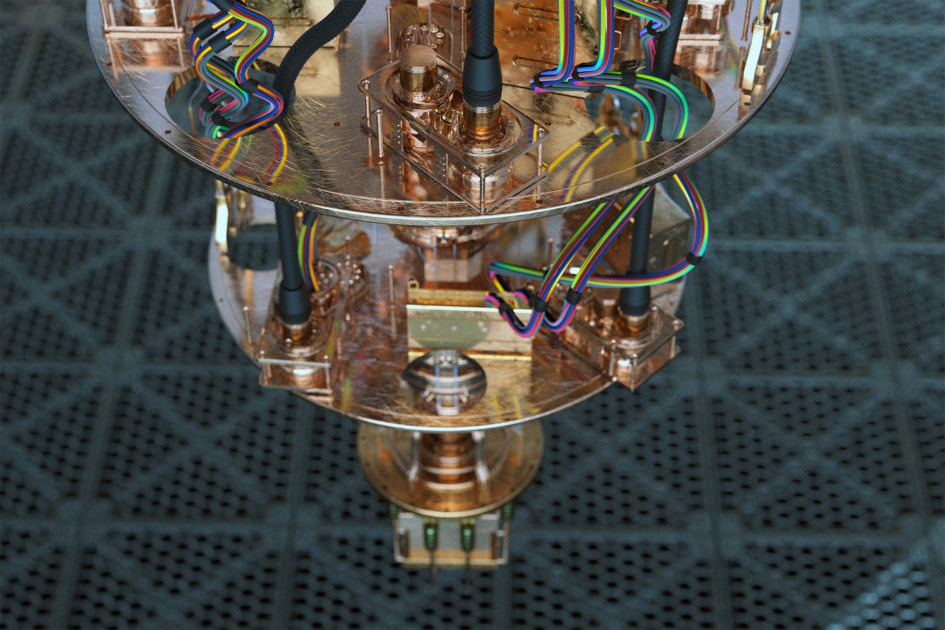
Because it pertains to quantum computing, strongly interacting topological supplies might be able to defend qubits from forgetting their quantum state, a course of referred to as decoherence.
Associated
“If we may encode the quantum data in a topologically protected state, it’s much less vulnerable to exterior noise that may by accident swap the qubit,” mentioned Hoffman. “Microsoft already has a big staff pursuing topological quantum computation in composite supplies and nanostructures. Our work demonstrates a primary in a single topological materials that harnesses sturdy electron interactions that may finally be used for topological quantum computing.”
“The following step can be to make use of the mix of topologically protected quantum states and powerful interactions to engineer novel quantum states of matter, akin to topological superconductors,” mentioned Dirk Morr, professor of physics on the College of Illinois, Chicago, and the senior theorist on the paper. “Their extraordinary properties may open unprecedented potentialities for the implementation of topological quantum bits.”
This analysis was co-authored by Yu Liu, Anjan Soumyanarayanan, Pengcheng Chen, Yang He, M.M. Yee, P.F.S. Rosa, J.D. Thompson, Dae-Jeong Kim, Z. Fisk, Xiangfeng Wang, Johnpierre Paglione, and M.H. Hamidian.
The digital measurements at Harvard and the samarium hexaboride crystal development at UC Irvine had been supported by the Nationwide Science Basis. The crystal development at College of Maryland was supported by the Gordon & Betty Moore Basis. Magnetic measurements at Los Alamos Nationwide Lab and theoretical work at College of Illinois had been supported by the Division of Power.
[ad_2]
Source link