[ad_1]
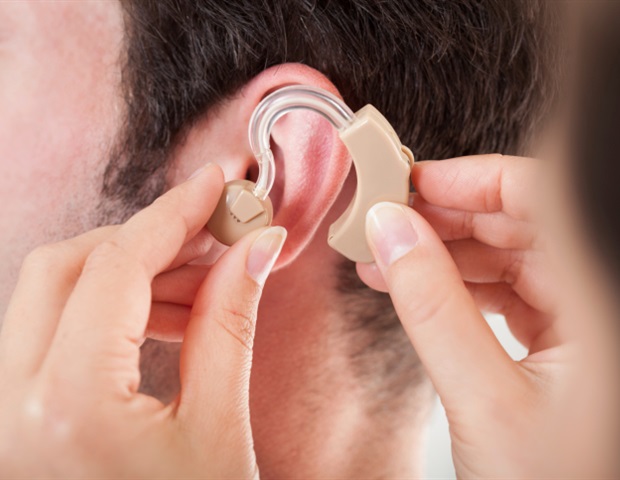
A crew of Brown College researchers has used a brain-computer interface to reconstruct English phrases from neural alerts recorded within the brains of nonhuman primates. The analysis, revealed within the journal Nature Communications Biology, might be a step towards growing mind implants that will assist folks with listening to loss, the researchers say.
What we have finished is to document the advanced patterns of neural excitation within the secondary auditory cortex related to primates’ listening to particular phrases. We then use that neural information to reconstruct the sound of these phrases with excessive constancy. The overarching purpose is to higher perceive how sound is processed within the primate mind, which may finally result in new forms of neural prosthetics.”
Arto Nurmikko, professor in Brown’s Faculty of Engineering, a analysis affiliate in Brown’s Carney Institute for Mind Science and senior writer of the examine
The mind methods concerned within the preliminary processing of sound are related in people and non-human primates. The primary degree of processing, which occurs in what’s referred to as the first auditory cortex, kinds sounds in keeping with attributes like pitch or tone. The sign then strikes to the secondary auditory cortex, the place it is processed additional. When somebody is listening to spoken phrases, for instance, that is the place the sounds are categorized by phonemes — the only options that allow us to tell apart one phrase from one other. After that, the data is distributed to different components of the mind for the processing that allows human comprehension of speech.
However as a result of that early-stage processing of sound is analogous in people and non-human primates, studying how primates course of the phrases they hear is helpful, despite the fact that they possible do not perceive what these phrases imply.
For the examine, two pea-sized implants with 96-channel microelectrode arrays recorded the exercise of neurons whereas rhesus macaques listened to recordings of particular person English phrases and macaque calls. On this case, the macaques heard pretty easy one- or two-syllable phrases — “tree,” “good,” “north,” “cricket” and “program.”
The researchers processed the neural recordings utilizing laptop algorithms particularly developed to acknowledge neural patterns related to explicit phrases. From there, the neural information might be translated again into computer-generated speech. Lastly, the crew used a number of metrics to judge how carefully the reconstructed speech matched the unique spoken phrase that the macaque heard. The analysis confirmed the recorded neural information produced high-fidelity reconstructions that have been clear to a human listener.
The usage of multielectrode arrays to document such advanced auditory info was a primary, the researchers say.
“Beforehand, work had gathered information from the secondary auditory cortex with single electrodes, however so far as we all know that is the primary multielectrode recording from this a part of the mind,” Nurmikko stated. “Primarily now we have practically 200 microscopic listening posts that can provide us the richness and better decision of information which is required.”
One of many objectives of the examine, for which doctoral pupil Jihun Lee led the experiments, was to check whether or not any explicit decoding mannequin algorithm carried out higher than others. The analysis, in collaboration with Wilson Truccolo, a computational neuroscience skilled, confirmed that recurrent neural networks (RNNs) — a kind of machine studying algorithm typically utilized in computerized language translation — produced the highest-fidelity reconstructions. The RNNs considerably outperformed extra conventional algorithms which were proven to be efficient in decoding neural information from different components of the mind.
Christopher Heelan, a analysis affiliate at Brown and co-lead writer of the examine, thinks the success of the RNNs comes from their flexibility, which is necessary in decoding advanced auditory info.
“Extra conventional algorithms used for neural decoding make robust assumptions about how the mind encodes info, and that limits the flexibility of these algorithms to mannequin the neural information,” stated Heelan, who developed the computational toolkit for the examine. “Neural networks make weaker assumptions and have extra parameters permitting them to be taught difficult relationships between the neural information and the experimental activity.”
Finally, the researchers hope, this sort of analysis may support in growing neural implants the might support in restoring peoples’ listening to.
“The aspirational state of affairs is that we develop methods that bypass a lot of the auditory equipment and go straight into the mind,” Nurmikko stated. “The identical microelectrodes we used to document neural exercise on this examine might someday be used to ship small quantities present in patterns that give folks the notion of getting heard particular sounds.”
Supply:
Journal reference:
Heelan, C., et al. (2019) Decoding speech from spike-based neural inhabitants recordings in secondary auditory cortex of non-human primates. Communications Biology. doi.org/10.1038/s42003-019-0707-9.
[ad_2]
Source link