[ad_1]
- Researchers from Georgia Tech and Ben-Gurion College of the Negev have used an affordable projector to trick Tesla’s Autopilot system.
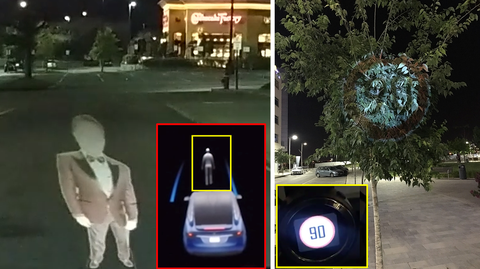
- By creating false positives, generally known as “phantom objects,” the crew made the automated driving system consider it noticed a pedestrian within the street and velocity restrict indicators in timber.
- All of it goes to point out that laptop imaginative and prescient methods is probably not as strong as we’re led to consider.
It is unsettling to think about that a $300 trick may idiot your considerably-more-expensive Tesla Autopilot system, and but, a crew of researchers from Ben-Gurion College of the Negev and Georgia Tech have pulled it off.
An affordable projector system displaying false velocity restrict indicators in timber or shining a Slenderman-like determine onto the street can truly power Autopilot to alter conduct, adjusting velocity to the “street indicators” and slowing down for what it thinks is perhaps a pedestrian (nevermind the truth that the automobile nonetheless runs over the projection).
These so-called “phantom objects” show that laptop imaginative and prescient nonetheless has a protracted technique to go earlier than self-driving vehicles can ever really be dependable as options for mass transit or private automobile possession. Accordingly, the researchers consult with their efforts as a “perceptual problem.”
However this experiment is not about monkeying round—this an actual safety and security hazard, the researchers level out in a brand new paper.
“We present how attackers can exploit this perceptual problem to use phantom assaults … with out the necessity to bodily method the assault scene, by projecting a phantom through a drone geared up with a transportable projector or by presenting a phantom on a hacked digital billboard that faces the Web and is situated close to roads,” they write within the summary.
Phantom Assaults
Ben Nassi
In Beersheba, Israel—dwelling of Ben-Gurion College of the Negev—Ben Nassi, lead writer of the projector paper, used an affordable, battery-operated projector and a drone to solid a picture of the scary determine onto the pavement. He needed to see if he may create a spoofing situation that any hacker may simply replicate with out having to disclose their identification.
Nassi examined out his principle towards Tesla’s Autopilot, in addition to Mobileye 630 PRO, one other of probably the most superior automated driver methods, which is utilized in vehicles just like the Mazda three. He projected a picture of a automobile onto the road, which the Mannequin X picked up on; created false velocity restrict indicators, which had been detected; and even created faux road strains that compelled the Tesla to modify lanes.
These are all examples of “phantom objects,” which Nassi describes as a depthless object that causes automated driving methods to understand it and contemplate it actual, resulting in all types of unintended penalties.
Nassi says phantoms aren’t only a concern within the wild by means of projector strategies like his personal, however that these false positives may be embedded into digital billboards, which are sometimes in a automobile’s body of imaginative and prescient. Within the picture beneath, focus your eyes on the highest left-hand nook. You must discover a sneaky phantom lurking round that might trigger a automobile to hurry up or decelerate to round 55 miles per hour. The image solely seems for 125 milliseconds, however it may trigger a large automobile accident.
Human Imaginative and prescient > Laptop Imaginative and prescient

This is not the primary time researchers have made autonomous autos look silly, if not utterly blind.
A Might 2018 paper from Princeton College and Purdue, for instance, confirmed that unhealthy actors may simply create “poisonous indicators” that imply one thing totally different to computer systems than individuals. The indicators’ peculiarities will likely be invisible to human eyes, however can have dire penalties on autonomous autos’ imaginative and prescient methods.
“These assaults work by including carefully-crafted perturbations to benign examples to generate adversarial examples,” the authors write. “Within the case of picture information, these perturbations are sometimes imperceptible to people.”
In one other case, researchers performed what they name a “disappearance assault” to cover a cease signal from a deep neural community. By merely masking the true cease signal with an adversarial cease signal poster or including stickers to the cease signal, the neural web was confounded.
Nassi and his crew consult with this incapability of automated autos to double-check what they’re seeing because the “validation hole.”
The answer is straightforward, they posit: Producers of automated driving methods must be engaged on communication methods to assist the pc imaginative and prescient methods double-check that what it is seeing is actuality. This can be a broadly accepted viewpoint, they are saying, however key stakeholders have delayed the manufacturing of those instruments that might rule out 2D objects just like the Slenderman projection.
When these ultimately roll out, the methods will enable autos to kind of speak to 1 one other to find out in the event that they’re seeing the identical factor. In different instances, imaginative and prescient methods put in on buildings or different infrastructure may additionally talk with the vehicles. This can be a imaginative and prescient of a related world that may in all probability require 5G to work, however is solely believable.
Till these communication aids hit the mass-market, undoubtedly preserve your eyes open and alert whereas driving your Tesla.
[ad_2]