[ad_1]
A quantum internet could possibly be used to ship un-hackable messages, enhance the accuracy of GPS, and allow cloud-based quantum computing. For greater than 20 years, goals of making such a quantum community have remained out of attain largely due to the problem to ship quantum indicators throughout massive distances with out loss.
Now, Harvard and Massachusetts Institute of Expertise (MIT) researchers have discovered a approach to appropriate for sign loss with a prototype quantum node that may catch, retailer and entangle bits of quantum info. The analysis is the lacking hyperlink in direction of a sensible quantum web and a serious step ahead within the growth of long-distance quantum networks.
“This demonstration is a conceptual breakthrough that might prolong the longest doable vary of quantum networks and doubtlessly allow many new purposes in a fashion that’s inconceivable with any present applied sciences,” stated Mikhail Lukin, the George Vasmer Leverett Professor of Physics and a co-director of Harvard Quantum Initiative. “That is the conclusion of a purpose that has been pursued by our quantum science and engineering neighborhood for greater than twenty years.”
The analysis is revealed in Nature.
Each type of communication know-how — from the primary telegraph to at the moment’s fiber optic web — has needed to tackle the truth that indicators degrade and are misplaced when transmitted over distances. The primary repeaters, which obtain and amplify indicators to appropriate for this loss, have been developed to amplify fading wire telegraph indicators within the mid-1800s. 2 hundred years later, repeaters are an integral a part of our long-distance communications infrastructure.
In a classical community, if Alice in New York needs to ship Bob in California a message, the message travels from coast to coast in roughly a straight line. Alongside the best way, the sign passes by way of repeaters, the place it’s learn, amplified and corrected for errors. The entire course of is at any level weak to assaults.
If Alice needs to ship a quantum message, nonetheless, the method is totally different. Quantum networks use quantum particles of sunshine — particular person photons — to speak quantum states of sunshine over lengthy distances. These networks have a trick that classical methods don’t: entanglement.
Entanglement — what Einstein referred to as “spooky motion at a distance” — permits bits of data to be completely correlated throughout any distance. As a result of quantum methods can’t be noticed with out altering, Alice might use entanglement to message Bob with none worry of eavesdroppers. This notion is the muse for purposes such quantum cryptography — safety that’s assured by the legal guidelines of quantum physics.
Quantum communication over lengthy distances, nonetheless, can be affected by typical photon losses, which is likely one of the main obstacles for realizing large-scale quantum web. However the identical bodily precept that makes quantum communication ultra-secure additionally makes it inconceivable to make use of present, classical repeaters to repair info loss.
How will you amplify and proper a sign for those who can’t learn it? The answer to this seemingly inconceivable job includes a so-called quantum repeater. In contrast to classical repeaters, which amplify a sign by way of an present community, quantum repeaters create a community of entangled particles by way of which a message might be transmitted.
In essence, a quantum repeater is a small, special-purpose quantum pc. At every stage of such a community, quantum repeaters should be capable of catch and course of quantum bits of quantum info to appropriate errors and retailer them lengthy sufficient for the remainder of the community to be prepared. Till now, that has been inconceivable for 2 causes: First, single photons are very troublesome to catch. Second, quantum info is notoriously fragile, making it very difficult to course of and retailer for lengthy durations of time.
Lukin’s lab, in collaboration with Marko Loncar, the Tiantsai Lin Professor of Electrical Engineering on the Harvard John A. Paulson Faculty of Engineering and Utilized Sciences (SEAS), Hongkun Park, Mark Hyman Jr. Professor of Chemistry on the Harvard School of Arts and Sciences (FAS), and Dirk Englund, affiliate professor of electrical engineering and pc science at MIT, has been working to harness a system that may carry out each of those duties properly — silicon-vacancy colour facilities in diamonds.
These facilities are tiny defects in a diamond’s atomic construction that may take in and radiate gentle, giving rise to a diamond’s good colours.
“Over the previous a number of years, our labs have been working to grasp and management particular person silicon-vacancy colour facilities, notably round use them as quantum reminiscence gadgets for single photons,” stated Mihir Bhaskar, a Graduate Faculty of Arts and Sciences (GSAS) scholar within the Lukin group.
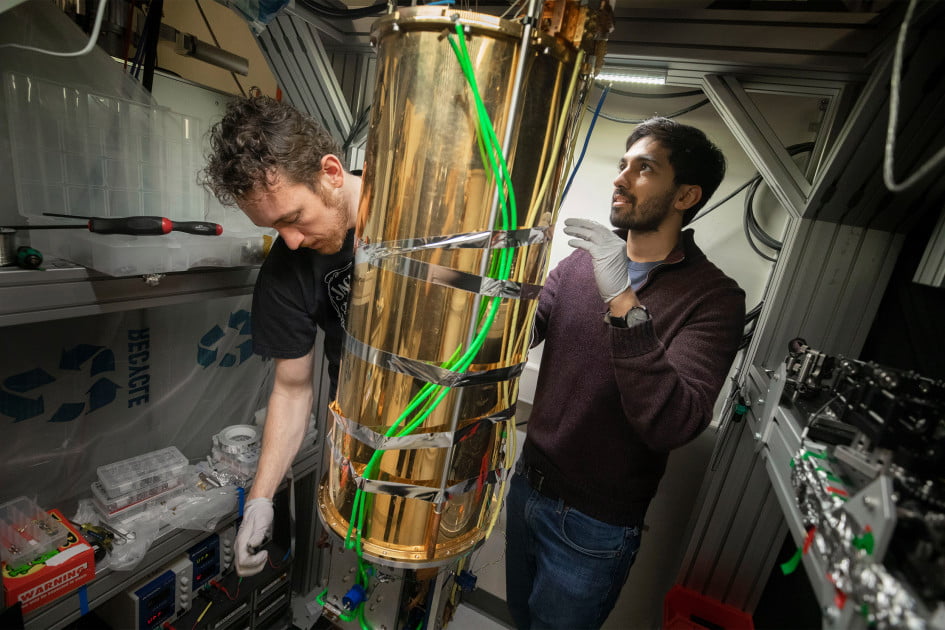
The researchers built-in a person color-center right into a nanofabricated diamond cavity, which confines the information-bearing photons and forces them to work together with the one color-center. They then positioned the gadget in a dilution fridge, which reaches temperatures near absolute zero, and despatched particular person photons by way of fiber optic cables into the fridge, the place they have been effectively caught and trapped by the color-center.
The gadget can retailer the quantum info for milliseconds — lengthy sufficient for info to be transported over hundreds of kilometers. Electrodes embedded across the cavity have been used to ship management indicators to course of and protect the knowledge saved within the reminiscence.
“This gadget combines the three most essential parts of a quantum repeater — a protracted reminiscence, the flexibility to effectively catch info off photons, and a approach to course of it domestically,” stated Bart Machielse, a GSAS scholar within the Laboratory for Nanoscale Optics. “Every of these challenges have been addressed individually however nobody gadget has mixed all three.”
Associated
“At the moment, we’re working to increase this analysis by deploying our quantum recollections in actual, city fiber-optic hyperlinks,” stated Ralf Riedinger, a postdoctoral candidate within the Lukin group. “We plan to create massive networks of entangled quantum recollections and discover the primary purposes of the quantum web.
“That is the primary system-level demonstration, combining main advances in nanofabrication, photonics and quantum management, that reveals clear quantum benefit to speaking info utilizing quantum repeater nodes. We look ahead to beginning to discover new, distinctive purposes utilizing these strategies,” stated Lukin.
The analysis was co-authored by Bhaskar, Riedinger, Machielse, David Levonian, Christian Nguyen, Erik Knall, Park, Englund, Loncar, Denis Sukachev, and Lukin.
It was supported partially by the Nationwide Science Basis, the Division of Protection, the Division of Power, the Air Power Workplace of Scientific Analysis and Workplace of Naval Analysis.
[ad_2]