[ad_1]
Harlan is a hero to many, if not most, constitutional legal professionals. Justice Thurgood Marshall, the primary Black justice on the Supreme Court docket, is alleged to have “admired the braveness of Harlan greater than any justice who has ever sat on the Supreme Court docket.” In his lowest moments because the lead lawyer for the NAACP Authorized Protection Fund, Marshall renewed his braveness by studying Harlan’s 1896 dissent in Plessy v. Ferguson, the SCOTUS resolution permitting segregation in the USA. Marshall believed that Chief Justice Earl Warren’s 1954 opinion in Brown v. Board of Schooling — the case that overturned Plessy by declaring segregation unlawful and that Marshall himself argued — was secondary at finest. As Marshall noticed it, in accordance with a colleague, “Earl Warren was writing for a unanimous Supreme Court docket. Harlan was a solitary and lonely determine writing for posterity.”
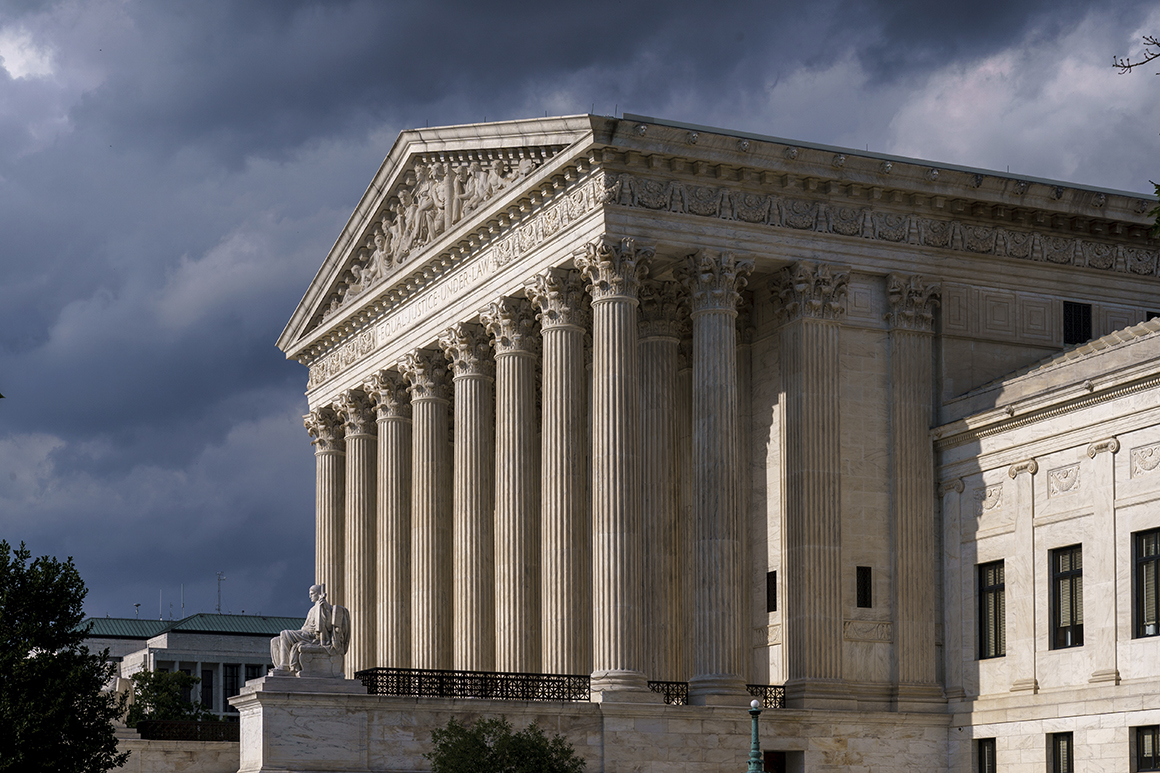
Why identify the constructing in any respect, you may ask? In spite of everything, the White Home and the Capitol haven’t been named after historic figures both. As an alternative of tying the seats of our branches of presidency to anybody individual’s legacy, the USA has chosen to maintain them nameless, speaking their which means and objective by means of the instance of successive generations as an alternative.
However, no less than relating to the Supreme Court docket, that’s not working. The American individuals are dropping any shared sense they ever had of what the Supreme Court docket stands for and what it ought to signify. Right this moment, approval of the Supreme Court docket is at a historic low. The constructing’s symbolic anonymity — just like the robes that the justices put on — is now not the supply of power it was.
Our nation is revisiting our historical past. We’re wrestling with how we must always inform that historical past and who we must always honor. We battle at this time with tips on how to discuss Thomas Jefferson, who wrote that “all males are created equally” as he held males in chains. Or whether or not we must always have a good time Alexander Hamilton, who fought for the ratification of a Structure that counted enslaved folks as merely three-fifths of an individual. Or how to consider the Supreme Court docket as an establishment that’s meant to make sure justice and but as soon as held that not one of the rights or privileges of American citizenship could possibly be bestowed upon even free Black folks.
Harlan embodies that battle. As described in Peter Canellos’ current biography, The Nice Dissenter, Harlan was born to a slave-owning household in Kentucky, the son of James Harlan. (Canellos is an editor at Politico.) Earlier than John was born, an Eight-year-old boy and his mom confirmed up at James Harlan’s home. There are rumors that the boy was James’ son, however all we all know for certain is that James took within the mixed-race boy — who was named Robert Harlan and would go on to grow to be one of the distinguished Black People of his day — bought the boy’s mom down South, and ensured that Robert obtained an training alongside John and his different youngsters.
From then on, Robert’s and John’s tales grew to become inextricably linked, and they’re as painful as they’re redemptive.
Within the years earlier than the Civil Struggle, as a budding politician blessed with all of the privileges of rising up in a distinguished household, John Marshall Harlan believed that preserving the union was paramount — and that abolishing slavery was not. He campaigned for the Know-Nothing Celebration regardless of their virulently anti-immigrant and anti-Catholic platform principally as a result of they weren’t abolitionists or secessionists. He was instrumental in maintaining Kentucky from becoming a member of the Confederacy and fought within the Union Military, however criticized President Abraham Lincoln’s warfare time measure emancipating all slaves in insurgent states.
Within the aftermath of the warfare, Robert Harlan thrived as a rich, cosmopolitan, self-made Black man in Ohio. Buddies with President Ulysses S. Grant and politically influential inside the Republican Celebration, he — alongside Frederick Douglass and P.B.S. Pinchback — strove to create alternatives for Black communities. However as federal occupation of the South grew to become politically untenable and the Ku Klux Klan, mob lynchings, and full-throated, legally mandated segregation took maintain, the long run Robert Harlan envisioned for Black America started slipping away. In the meantime, the person he was raised with — John Harlan — was being thought-about for a seat on the Supreme Court docket. When cautious Republicans doubted John’s commitments to the postwar civil rights amendments, it was Robert who used his political connections contained in the Rutherford B. Hayes administration to vouch for John. Simply six days after Robert assured John he would get the nod, Hayes submitted John’s nomination to the Senate Judiciary Committee.
After he made it onto the court docket, Justice Harlan and his spouse grew to become the final word Washington insiders. She was a confidant of first woman Lucy Hayes and threw common cocktail events attended by lots of of Washington’s most elite. He was a favourite visitor lecturer at what would grow to be George Washington College and the D.C. Bar Affiliation, identified for his beauty, athletic talents, buoyant humor and colourful storytelling.
However when it got here to his job on the Supreme Court docket, John Marshall Harlan stood alone. In case after case, Harlan dissented. Regardless of his wavering political positions earlier than becoming a member of the Court docket, Harlan wrote clearly again and again that continued racial injustice and inequality was an existential menace to the Structure. When the court docket struck down the 1875 Civil Rights Act that had assured Black People entry to railroads, inns and theaters, he dissented. When the court docket undermined the flexibility of the federal government to interrupt up unlawful monopolies, he dissented. And when the court docket determined that purportedly separate however equal railroad automobiles had been constitutional, no different justice joined when he wrote “within the view of the Structure, within the eye of the regulation, there may be on this nation no superior, dominant, ruling class of residents … all residents are equal earlier than the regulation.”
One among his dissents prompted a letter from Douglass in 1883 by which Douglass reminded Harlan that “one man with God is a majority.”
As a brand new mom, I take into consideration Harlan in another way now. I used to admire his braveness and his clearness of objective. It felt like he was talking by means of the many years to these of us sitting in our regulation faculty school rooms. However now I take into consideration tips on how to elevate a baby to be each in and of his time and but be capable of see so clearly what everybody round him can not. He stands for the concept that anybody can discover reality whatever the circumstances of their upbringing, that it’s by no means too late to alter your thoughts, and that one individual’s voice can transfer us that a lot nearer to fulfilling the promise of the American experiment.
At first, Harlan argued to protect the union in any respect prices. Then he fought in a warfare to take care of it. And after the warfare, when he noticed that the poison of racism and segregation had been as soon as once more set to destroy his beloved nation — understanding that he couldn’t persuade his contemporaries of what he knew to be true — he wrote to all of us as an alternative. He was not excellent. You will discover in his writings any variety of issues to object to. I don’t defend them.
However is it not additionally becoming to acknowledge — to raise up for example to our kids — those that modified for the higher? After we take into consideration our historical past, we’re proper to honor these whose very lives stood for justice and mercy and inerrant knowledge. However what about those that struggled to search out the appropriate reply and grew? And people who — once they had been lonely of their convictions — refused to associate with the gang?
On this second once we lastly have the political will to tear down monuments to Accomplice traitors, could we not additionally construct them to sophisticated union heroes that remind us that our Supreme Court docket’s historical past could also be stuffed with disappointments and failings however that there are those that will stand alone to bend its ethical arc towards justice?
[ad_2]
Source link