
How Big ISPs Are Trying to Burn California’s $7 Billion Broadband Fund
[ad_1]
A month in the past, Governor Newsom introduced a plan to take a position $7 billion of federal rescue funds and state surplus to be largely invested into public broadband infrastructure meant to serve each Californian with reasonably priced entry to infrastructure prepared for 21st century calls for. In brief, the proposal would empower the state authorities, native governments, cooperatives, non-profits, and native non-public entities to make the most of the to construct common 21st century entry. With that degree of cash, the state might finish the digital divide—if invested accurately.
However, thus far, business opposition from AT&T and cable have efficiently sidelined the cash—as EFF warned earlier this month. Now, they’re trying to reshape how the state spends a once-in-a-generation funding of funds to get rid of the digital divide into wasteful spending and an enormous subsidy that will go into the business’s arms. Earlier than we break down the woefully inadequate business different proposals which might be circulating in Sacramento, it is vital we perceive the character of California’s broadband downside as we speak, and why Governor Newsom’s proposal is a direct technique of fixing it.
Trade’s Already Proven Us How Revenue-Pushed Deployment Leaves Folks Behind
This can’t be emphasised sufficient, however main business gamers are discriminating towards communities that will be worthwhile to completely serve in the long run. Why? These enormous firms have opted to increase their short-term earnings via discriminatory decisions towards the poor. That’s how California grew to become the setting for a stark illustration of the digital divide within the pandemic: an image of little women doing homework in a quick meals car parking zone so they may entry the web. That was not in a rural market, the place households are extra spaced out. That was Salinas, California, a metropolis with a inhabitants of 155,000+ individuals at a density of 6,490 individuals per sq. mile. There was no good cause why these little youngsters didn’t have low cost, quick web at house. We should always disabuse ourselves of the notion that any business subsidy will change how they method the enterprise of deploying broadband entry.
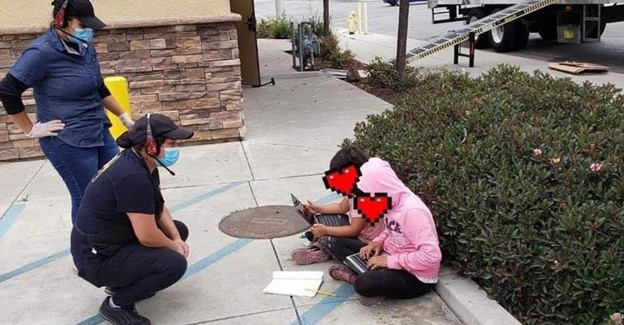
From https://twitter.com/kdeleon/standing/1299386969873461248
And within the lack of significant digital redlining regulation, it’s completely pure for business to decide to discriminate towards low-income neighborhoods due to the pressures to ship quick earnings to traders. It’s why dense, city markets that will be worthwhile to serve, comparable to Oakland and Los Angeles, have a well-documented and completely studied digital redlining downside. Analysis exhibits that it’s largely Black and brown neighborhoods which might be left out for 21st century community investments. It is usually the identical cause why individuals in rural California undergo from systemic underinvestment in networks that led to one of many largest non-public telecom bankruptcies in trendy occasions—impacting hundreds of thousands of Californians. If the revenue will not be quick sufficient, they won’t make investments, and throwing extra authorities cash at these quick time period targeted firms won’t ever repair the issue.
Huge web service suppliers have proven us many times that they won’t put money into areas that current an unattractive revenue price for his or her shareholders. On common, it takes a community about 5 years to completely deploy, and new networks had been first deployed in these firms’ favored areas properly over a decade in the past. No quantity of presidency cash from a one-time capital expenditure standpoint will change their estimations of who is an acceptable long-term payer for his or her non-public services. Their conclusions are hard-wired into expectations pushed by Wall Road traders for his or her skill to pay dividends and hold delivering constant earnings sure households will ship to them. Their priorities is not going to change because of more cash from the state. Even with extra aggressive regulation to deal with worthwhile but discriminated towards areas, the non-public business will not be capable of handle areas that may yield zero revenue to supply service.
The one means to achieve 100% common entry with 21st century fiber broadband at reasonably priced costs is to advertise domestically held options and aggressively put money into public broadband infrastructure. Some rural communities can solely be totally served by a neighborhood entity that may take a 30-to-40-year debt funding technique that isn’t topic to stress from far-off traders to ship earnings. That’s precisely how we acquired electrical energy out to rural communities. Broadband being an important service, the expectations of constant income from rural residents to maintain their very own networks align properly with making long-term bets—as envisioned by Governor Newsom’s proposal to create a Mortgage Loss Income Reserve Account. This account will allow long-term low-interest infrastructure financing. And, most significantly, it’s solely potential to ship reasonably priced entry for low-income customers in lots of locations if we decouple the revenue motive with the provisioning of this important service. For proof of this, look no additional than Chattanooga, Tennessee, the place 17,700 households with low-income college students will take pleasure in 10 years of free 100/100mbps fiber web entry on the zero revenue value of $eight.2 million.
If we need to make 21st century-internet one thing everybody can entry no matter their socioeconomic standing and placement, we have to use all of the choices obtainable to us. The non-public market has its function and significance. However actually reaching 100% entry will not be potential with out a robust public mannequin to cowl those that are most tough to achieve.
What Trade Is Really Asking Sacramento To Do With Our Cash
The ideas the cable business and AT&T are making to Sacramento proper now fail us twice over. They won’t really clear up the issue our state faces. They will even set us down a path of perpetual business subsidization and sabotage of the general public mannequin. These ideas appear targeted on blocking the state authorities from pushing middle-mile fiber deep into each group, which is a mandatory pre-condition to make sure a neighborhood non-public or public answer is financially possible. Nonetheless, the mere existence of some connectivity in or close to an space doesn’t imply there’s the capability to ship 21st century entry. Fixing that downside requires fiber. And it’s the dearth of accessible fiber (predominantly in rural areas) that stops native options from taking root in lots of locations, even these which might be motivated. Trade has no answer to supply in these locations, as a result of it has at all times prevented investing in these areas.
Let’s begin with cable firms’ particular ideas. This business has a really lengthy historical past of opposing municipal fiber to protect high-speed monopolies. And so their recommended change to Governor Newsom’s plan comes as no shock as a result of all it might do is jam all of the funding into the present California Superior Companies Fund (CASF), which they supported in 2017. CASF has completely didn’t make vital progress in eliminating the digital divide. EFF has detailed why California’s broadband program is in determined want of an replace and has sponsored laws to undertake a 21st century infrastructure commonplace within the face of business opposition—which prevented wanted adjustments to CASF within the top of the pandemic, with an help from California’s Meeting.
There isn’t a saving grace for the present broadband infrastructure program. CASF has spent an obscene quantity of public cash on out of date sluggish connections that had been nugatory throughout the pandemic because of legislative restrictions the business sought. Its present guidelines additionally make massive swathes of rural California ineligible for broadband investments, and it prioritizes non-public business investments by blocking most native authorities bidders. It’s no shock cable suggests we spend one other $7 billion on that failed experiment.
Arguably the worst suggestion the cable business makes to Governor Newsom’s plan is to get rid of the long-term financing program that will assist native governments entry the bond market, and as an alternative cram it into the failed CASF program. Doing that will imply native communities can be barred from changing 1990s-era connections with fiber, and proceed to reward the business’s technique of discriminating towards low-income Californians and prioritizing the rich. That may successfully destroy the power of native governments to finance community-wide upgrades, which is a core technique of rural county governments left to cope with the wake of the Frontier Communications chapter. By sabotaging the long-term financing program, cable ensures native governments have little probability of financing their very own networks—and that’s the total level. If Sacramento needs to see everybody in rural California and underserved cities related, then group networks have to be community-wide to make long-term financing the price of the complete community to all individuals reasonably priced. Forcing the general public sector to offset the discriminatory decisions of business solely rewards that discrimination and makes these group options financially infeasible.
AT&T, which has by no means lacked humility when speaking to Sacramento legislators, has gone as far to say in a letter to the legislature that constructing out capability to each group one way or the other prevents native last-mile options from taking root. That’s a bogus argument. When you don’t have capability at an reasonably priced price provisioned to a group, there can by no means be a neighborhood answer. If that capability is already obtainable to rural communities as we speak at a value level that permits native options, then we might be seeing it in rural communities as we speak. So, except AT&T is planning to indicate the state and native communities precisely the place—and at what value—it’s providing center mile fiber to rural communities, legislators ought to simply ignore this apparent misdirection.
What can be notably irritating to learn in AT&T’s letter is the argument that barely anybody wants infrastructure in California to have interaction in distant work, telehealth, and distance schooling. The letter goes as far as to say solely 463,000 households want entry.
This simply will not be true. For starters, AT&T’s estimate is premised on the idea that a particularly sluggish 25/three mbps broadband connection is greater than sufficient to make use of the web as we speak. That commonplace was established in 2015, lengthy earlier than the pandemic reshaped entry wants. It’s successfully ineffective as we speak as a metric to evaluate infrastructure, as a result of it obscures the extent to which the business has under-invested in 21st century prepared entry. Nobody builds a community as we speak to simply ship 25/three mbps. Doing so can be a huge waste of cash. Something new constructed as we speak is constructed with fiber, with out exception. The suitable evaluation of the state’s communications infrastructure ought to boil down to at least one query: who has fiber?
The truth, per state knowledge, is that simply to fulfill the Governor’s minimal metric of 100 mbps obtain the variety of households that want assist rises by 100,000s above AT&T’s estimate. And if we would like 21st century fiber-based infrastructure entry all through the state, as envisioned by President Biden and Governor Newsom’s proposal, now we have hundreds of thousands of properties to attach—one thing that may be achieved with a $7 billion funding.
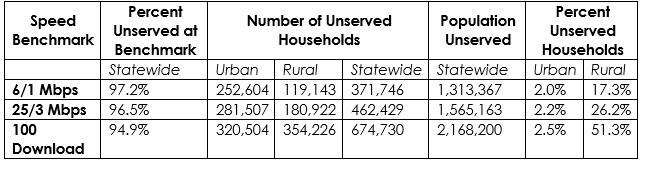
The selection for Sacramento ought to be simple. An funding on the measurement of $7 billion that may allow high-capacity fiber infrastructure all through the state will start a 21st century entry transition for all Californians who lack it as we speak. Adopting AT&T’s imaginative and prescient of narrowly funneling the funds to a particularly restricted variety of Californians whereas shoveling the remainder of their coffers as subsidies will construct nothing.
[ad_2]
Source link